
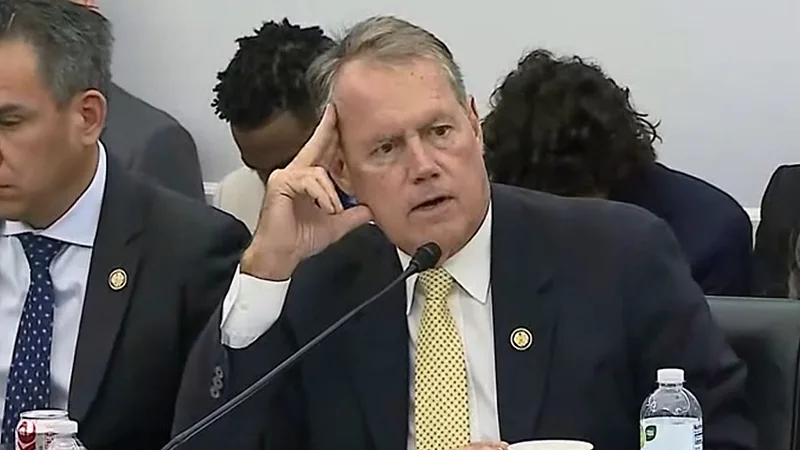
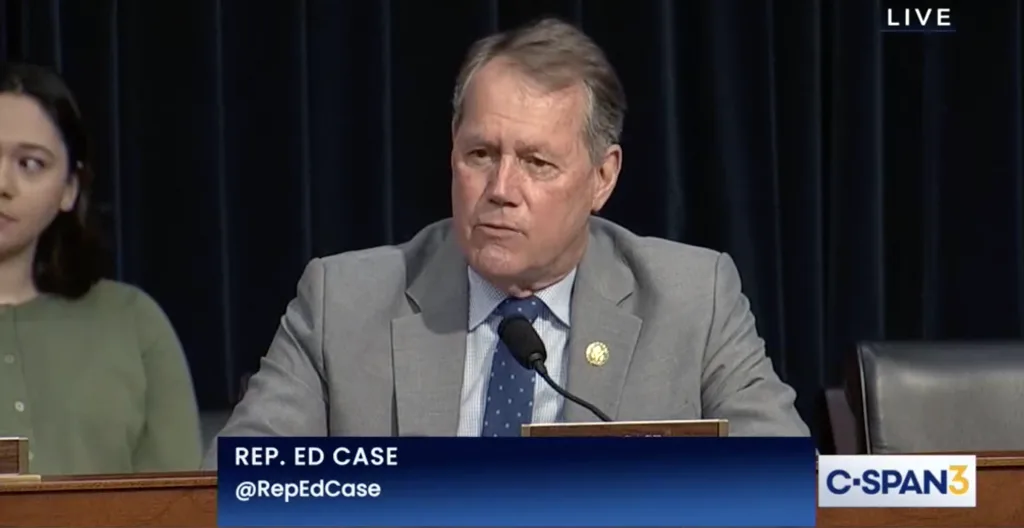
Ed Case has represented O'ahu's Congressional District 1 since 2018. His district is one of the most reliably Democratic in the country — which means his voting record and the positions he takes carry real weight for Hawaiʻi.
That record tells a troubling story. Time and again, Case has broken with the Democratic Party on issues that matter most to working families, sided with corporate donors over constituents, and defended positions that run counter to the values of the people he represents.
This page documents what Ed Case has done — and what he has failed to do — on the issues that affect Hawaiʻi.
Ed Case wants to restrict women and others from voting
Ed Case voted for the Republican-sponsored SAVE Act.
The SAVE Act creates a barrier to voter registration by requiring anyone who has changed their name — whether through marriage, divorce, or transition — to present a birth certificate or passport as proof of citizenship. There is no widespread voter fraud problem in the United States: nonpartisan research organizations have established this repeatedly, and committing voter fraud is already a crime. Ed Case voted to solve a problem that doesn't exist by making it harder for millions of Americans to register.
The law would affect an estimated 69 million women and others who have changed their names and would now need to produce original documents when registering to vote. That requirement falls hardest on people who have lost documents in a natural disaster, people who have moved, and transgender and nonbinary individuals whose documents may not reflect their current identity. The burden is real; the justification is not.
Learn more:
- The Safeguard American Voter Eligibility (SAVE) Act is a Trick — League of Women Voters
- Rep. Ed Case backs GOP-led bill requiring citizenship proof to vote — Honolulu Star-Advertiser
What voters say:
"You need to stand firm with the Democrats and stand up to Republicans trying to erode our democracy. The era of bipartisan cooperation is over. We must do everything to fight this immoral Trump regime, which is eroding immigrant rights, due process, climate/environmental progress, women's rights, and taking from the poor to give to billionaires!"
Rep. Case stood against affordability for working families
Ed Case and his "Unbreakable Nine" coalition helped derail President Biden's Build Back Better Act.
The Build Back Better Act (BBBA) was one of the most ambitious pieces of social legislation in a generation. For Hawaiʻi specifically, it would have taken 278,000 children out of poverty, provided $1.4 billion for affordable housing, established universal pre-K for the 83,000 children under age six in the state, and extended paid family and medical leave to 75 percent of Hawaiʻi workers who don't currently have it.
Case and a group of conservative Democrats sent a letter to Speaker Pelosi, insisting that the House pass a modified bill — the Inflation Reduction Act — before any budget resolution would be considered. By forcing that trade, he helped kill the broader social investment package and the programs within it:
- Paid family and medical leave (up to four weeks for caregiving and medical needs)
- Universal free preschool for 3- and 4-year-olds, plus major child care affordability provisions
- An expanded Child Tax Credit
- Substantial affordable housing investments, including public housing repairs and senior-focused housing
- Major expansion of Medicaid home- and community-based care for people with disabilities, elderly residents, and their caregivers
These were not abstract policy commitments. They were programs that would have materially changed the lives of hundreds of thousands of people in Hawaiʻi. Case chose a narrower bill instead.
Learn more:
- Case teams up with moderates to put the brakes on $3.5 trillion budget deal — Civil Beat
- Hawaiʻi Democrats: Rep. Case does not reflect party's values and principles — Civil Beat
- Congressman Ed Case disagrees with House Speaker's move on infrastructure — Hawaiʻi Public Radio
- Teachers disheartened over loss of child tax credit — Maui News
- 10 million children will fall back into poverty when the enhanced child tax credit ends — CNBC
What voters say:
"What was once the middle class is now the underclass. Most of us support fully socialized healthcare of the same quality you enjoy. We need the minimum wage to triple so people can survive and maybe have a little dignity. We need strong gun control so schools aren't murder prisons. Women need you to make pregnancy safe again, or many of them simply won't risk having children."
"The issue of affordability for the working class is not going away — people are struggling, unable to enjoy their lives and their families, incurring stress that leads to health problems and a lowered life expectancy, while watching the wealthy class flaunt their affluence. Most citizens have simple and deliverable desires: good wages, affordable housing, food stability, health care, and a healthy environment to enjoy."
Ed Case answers to billionaires, dark-money PACs, defense manufacturers, and big corporation
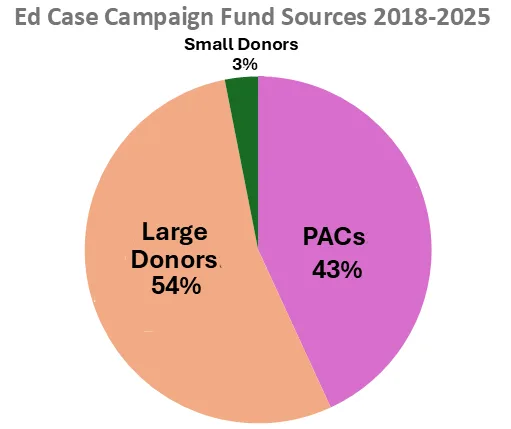
For the past seven years, the majority of Case's campaign contributions have come from out-of-state interests.
This matters because Case co-sponsored the For the People Act of 2019, which he said would "fix our broken political system so that our democracy truly works for all citizens and not the monied few." His own donor base tells a different story.
Case's donation totals from 2018 through September 2025:
| Source | Amount |
|---|---|
| PAC donations | $1,789,330 |
| Large donors ($250+) | $2,230,662 |
| Total from PACs and large donors | $4,019,992 |
| Small donors (under $200) | $128,409 |
Small donors represent barely 3% of Case's contributions.
This pattern goes back to his first term, when Case voted in favor of the Bankruptcy Abuse Prevention and Consumer Protection Act — a bill that eased restrictions on U.S. bankruptcy law and repealed the Estate Tax, both measures that primarily benefit the wealthy.
Learn more:
- Hawaii Rep. Ed Case raised 99% of campaign money from PACs — Civil Beat
- Case may not always vote with Dems, but his fundraising is going just fine — Civil Beat
- Chamber of Commerce runs ads for Ed Case — Daily Kos
What voters say:
"Stop taking money from corporations and working for the 1%. You work for us."
He refused to defend Hawaiʻi from ICE
Ed Case refused to join Hawaiʻi's congressional delegation in condemning abusive ICE tactics in the state.
In July 2025, Senators Hirono and Schatz, along with Representative Tokuda, wrote to Homeland Security Secretary Kristi Noem stating that ICE agents were "creating fear and terrorizing communities" in Hawaiʻi. Case refused to sign the letter.
He also declined to join Representative Jill Tokuda in a Democratic initiative to impeach Noem for enabling criminal and violent behavior by ICE and Border Patrol agents. When a constituent raised the issue of ICE acting unlawfully and using excessive force, Case responded: "While we can improve ICE, I do not believe that cutting funding for ICE is the right solution to our immigration issues."
Rather than treating the documented pattern of ICE abuses as what it is — masked, unaccountable agents using violence against immigrants and U.S. citizens alike — Case framed it as a routine law enforcement and border security matter. His refusal to stand with his colleagues left Hawaiʻi's communities without the unified congressional voice they deserved.
Read how Ed Case defends his inaction to constituents
Learn more:
- Hawaiʻi delegation divided over letter condemning ICE — Aloha State Daily
- As immigrant arrests rise, not all Hawaiʻi political leaders condemn ICE tactics — Civil Beat
What voters say:
"Why aren't you talking about the abuse of immigrants and citizens by ICE and the border patrol? Why aren't you showing up in person here in Hawaiʻi with us in the streets? Publicly stand up for the rule of law."
"You have not made any statements against ICE and how they are kidnapping people. ICE is racial profiling and it needs to stop. We are living in a horrible time and he needs to realize it and stand up for the people he represents."
Rep. Case tried to unseat revered US Senator Akaka
Breaking with Hawaiʻi political norms, Case challenged our first Native Hawaiian senator and elder statesman, Daniel Akaka, in the 2006 US Senate race.
Case's challenge wasn't grounded in policy disagreement. Senator Akaka's record was not at issue. The challenge was about advancing Case's own political career — at the expense of a senator whose seniority and relationships in Congress had taken decades to build, and whose position carried deep significance for Native Hawaiian people.
In their only debate, Akaka raised the value of experience and seniority. Case responded: "This is not about age. This is about reality. This is about transition."
The ILWU endorsed Senator Akaka and noted that in 2005 Case had voted five times to support business over working people, including votes to cut OSHA funding and to prevent companies from being sued in state court for wage and hour violations.
Mahealani Wendt, executive director of the Native Hawaiian Legal Corp., called Case's decision a direct affront to the Hawaiian community: "We're very proud that we have a senior statesperson holding national office. When the situation is created that he would be unceremoniously removed — not of his choosing — that is so insulting."
Case lost that race. He ran for Senate again in 2012, after Akaka formally retired, and lost to progressive champion Mazie Hirono in the primary. Today, at 73, he is fighting to prevent a younger, more progressive generation from representing Hawaiʻi.
Learn more:
- Brash, young and restless, Case seeks to upend Akaka — Civil Beat
- ILWU: What's at stake in Akaka vs. Case
What voters say:
"You challenged the great Senator Akaka when he was at his most vulnerable, showing that your own ambition matters more to you than the seniority and stability he provided for our islands. That was the day you lost the trust of the grassroots."
"Ed Case's challenge to Dan Akaka was a brazen act of ambition. He didn't care about the aloha way of doing things; he only cared about his own career. We haven't forgotten that he tried to push out a man who spent his life fighting for Native Hawaiians."
Case voted to designate Hawaiʻi non-profits as "terrorist-supporting organizations"
By supporting H.R. 9495, Ed Case voted to give Trump's Treasury Secretary the power to arbitrarily strip tax-exempt status from any organization he chose to label a terrorist supporter.
Had the bill passed the Senate, the administration could have designated any nonprofit — with no prior court challenge and no meaningful due process — as a "terrorist-supporting organization," effectively cutting off its funding and shutting it down. The Treasury Secretary would have had the final say on appeals.
There are more than 10,000 nonprofit organizations in Hawaiʻi, including schools and hospitals. Close to 75,000 local people are employed by them. Under H.R. 9495, any of those organizations could have been targeted. The chilling effect on private donors alone would have caused serious damage even without formal designation.
Although the bill failed in the Senate, the Trump administration used its framework as the basis for National Security Presidential Memo 7 (NSPM-7), which weaponizes the Treasury Department, the IRS, and the National Security Joint Task Force to achieve the same ends. NSPM-7 is already being used to target groups supporting immigrants' rights and those opposing ICE's methods.
Case voted for this bill three times.
Learn more:
- Hawaiʻi ACLU weighs in on HR 9495
- How NSPM-7 seeks to use "domestic terrorism" to target nonprofits and activists
What voters say:
"Stop colluding with the MAGA GOP and start working for the people you represent. We are in a fight to protect our democracy from a dictator. Your vote for the SAVE Act undermined our voting rights. Your votes — three times — for HR 9495 put all our essential public service groups and NGOs in danger of being attacked and dismantled."
Rep. Case voted to honor Charlie Kirk's legacy of hate speech
Case voted in favor of H.R. 719, a congressional resolution honoring right-wing provocateur Charlie Kirk.
Most Democrats voted "nay," "present," or abstained. Many who voted "present" (including Rep. Jill Tokuda) believed the resolution's language was too divisive and politically charged, but felt that voting "nay" might be misread as condoning political violence. Voting "present" was a principled middle ground that avoided tacitly endorsing Kirk's record.
By voting "yea," Case went further than most of his colleagues were willing to go: he actively endorsed a resolution celebrating a figure with a well-documented history of racist, misogynistic, and anti-LGBTQ+ rhetoric. That is a particularly striking choice for a representative from multicultural Hawaiʻi.
Learn more:
What voters say:
"Stop colluding with the MAGA GOP and start working for the people you represent. We are in a fight to protect our democracy from a dictator."
He also voted to censure Rep. Al Green for speaking truth to Trump
Case voted in favor of H.R. 189, censuring Representative Al Green of Texas for telling Trump that he had no mandate to cut Medicaid and social services, and that he was unfit for office.
Case explained his vote: "not because I disagree with what he said but because we must respect the institution." The logic might be more persuasive if Case had applied it consistently. Marjorie Taylor Greene and Lauren Boebert repeatedly heckled President Biden during his Congressional addresses. Case said nothing, did nothing, and sought no censure.
The standard, it seems, applies in one direction only.
Learn more:
Ed Case refused to engage with Hawaiʻi voters
When Indivisible Hawaiʻi invited all three Democratic primary candidates for the CD1 seat to participate in Talk Story interviews in December 2025, Ed Case declined.
The two challengers (Della Au Belatti and Jarrett Keohokalole) both accepted and sat down for interviews where IHSN members submitted questions in advance. Case chose not to participate. In his response, he disparaged Indivisible Hawaiʻi and dismissed the October 2025 Data for Progress poll that showed the race tightening significantly once voters learned more about the challengers.
- Find the Talk Stories interviews with Ed Case's challengers through this page, as well as the full email correspondence between IHSN and Ed Case
Case voted to extend the permit to spy on US citizens
Ed Case voted to renew Section 702 of the Foreign Intelligence Surveillance Act (FISA) — and rejected amendments that would have required warrants to search Americans' communications.
Section 702 allows the government to collect emails, texts, and phone calls of people outside the U.S., including their communications with Americans. While the program is aimed at foreign targets, the database contains vast amounts of data on U.S. citizens. Intelligence and law enforcement agencies (FBI, NSA, CIA) can search that database using Americans' names, email addresses, or phone numbers without a warrant. These are known as "backdoor searches."
The FBI has historically performed tens of thousands of these searches every year. In 2022 alone, there were over 200,000 recorded searches. Investigations revealed that the FBI used Section 702 to query information on protesters, journalists, members of Congress, and thousands of donors to a congressional campaign.
Section 702 was set to expire on April 30, 2026. The day before, on April 29, the House approved a three-year extension by a vote of 235–191. The bill did not include an amendment that would have required federal agencies to obtain a warrant before querying data on U.S. citizens. Forty-two House Democrats, including Ed Case, joined the Republican majority to pass the bill.
The Senate rejected the House's three-year extension and instead passed a 45-day stopgap measure by unanimous consent.
By voting for the House bill, Case gave FBI Director Kash Patel three more years to continue using the FISA process to conduct warrantless searches of Americans' communications. Once again, he sided with Republicans over the concerns of civil liberties advocates and his own party — and he neutralized Representative Jill Tokuda's vote in the process, reducing Hawaiʻi's impact on national policy.
What you can do
Ed Case's district is one of the most reliably Democratic in the country. That means the Hawaiʻi State primaries in August 2026 are where this election will be decided.
→ Find out about the 2026 primaries and how you can help
→ Register to vote in Hawaiʻi
