
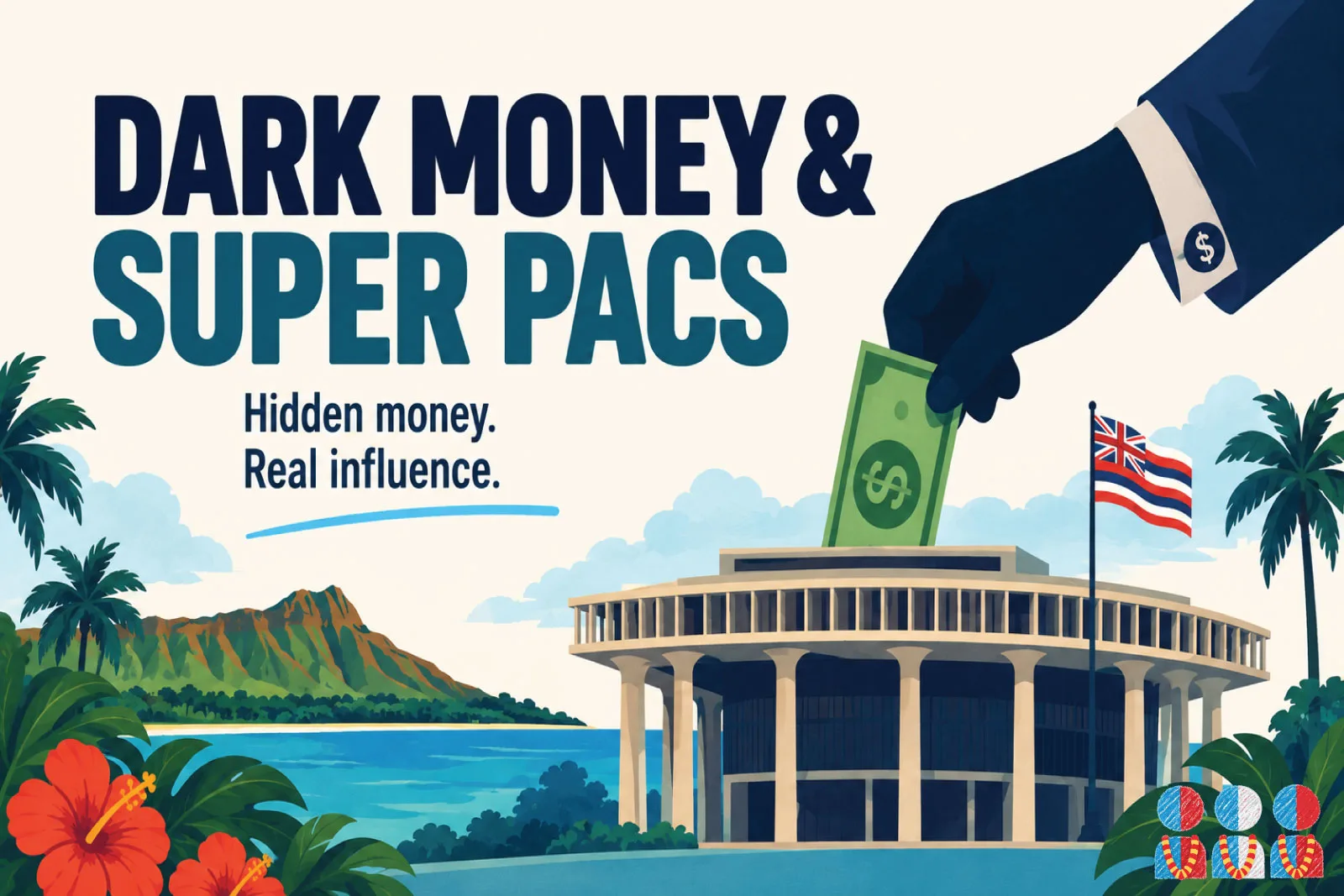
Dark money refers to political spending from undisclosed sources. Unlike regular campaign donations where you can see exactly who gave how much, dark money flows through legal loopholes that hide the identity of donors. When you don't know who's funding a political message, you can't evaluate their motives or hold them accountable.
How campaign finance used to work
For over a century, federal campaign finance law required transparency. If you wanted to support a candidate:
- Individuals could donate up to $3,500 per campaign
- Corporations and unions could pool employee or member donations through Political Action Committees (PACs), with a limit of $5,000 per campaign
- All donors had to be disclosed in public filings with the Federal Election Commission (FEC)
This system wasn't perfect, but voters could at least see who was backing each candidate.
What changed in 2010
In 2010, the US Supreme Court decided Citizens United v. FEC. The ruling created a new type of political committee called "Independent Expenditure-Only Committees"—now commonly known as Super PACs.
The court's reasoning: corporations and unions should have the same free speech rights as individual people. Justice Kennedy, writing for the majority, argued that political contributions "don't raise issues of corruption, or even the appearance of corruption."
As Avi Soifer, Emeritus Professor and Former Dean of Richardson Law School at UH Manoa, later observed: "I'm afraid we know better than the court at that point knew. It was a naive statement, and we've seen dark money, and we've seen billionaires bragging about how much they gave."
How Super PACs create dark money
Super PACs can raise and spend unlimited amounts. But here's where dark money enters the picture:
- A wealthy donor wants to influence an election without anyone knowing
- They donate to a shell corporation set up as a nonprofit under IRS code §501(c)(4)
- These nonprofits don't have to disclose their donors
- The nonprofit then donates to a Super PAC
- The Super PAC spends the money on political ads and campaigns
The money is technically "disclosed" when the Super PAC reports receiving it from the nonprofit, but the original source remains hidden.
Traditional PACs vs. Super PACs
| Traditional PAC | Super PAC (post-2010) | |
|---|---|---|
| Corporate/union treasury funds | Prohibited | Unlimited |
| Who can donate | Individuals only (employees/members) | Individuals, corporations, unions |
| Contribution limits | $5,000 per individual per year | Unlimited |
| Direct candidate support | Yes—up to $5,000 per election | No—must be "independent" |
| Donor disclosure | Required | Required (but can be a shell nonprofit) |
The impact
When billionaires and corporations can spend unlimited money without revealing themselves, voters can't evaluate the source of political messages. You can't hold someone responsible if you don't know who they are. There's no way to track whether elected officials are serving their constituents or their secret funders. Corporate spending drowns out individual voices.
In the 2024 presidential race alone, over $1 billion was spent through these channels, with most sources completely anonymous. Dark money spending far outstripped individual contributions.
What can be done
States are beginning to push back. Hawaiʻi passed Act 11 in 2026, becoming the first state to limit corporate political spending by redefining corporate powers under state law. Learn more about how Act 11 works.
To stay informed about campaign finance reform efforts, sign up for the IHSN newsletter.
